
Youth Workers Platform Launched by YAO at GYWC 2025

The Youth Arise Organization has introduced the Youth Workers Multi-stakeholder Platform to facilitate collaboration and knowledge sharing among global youth workers. Unveiled at the Global Youth Workers Conference 2025 in Accra, the initiative aims to create a network focused on transforming young lives through shared learning and advocacy.
Youth Work in Ghana: Why It’s Not a One-Man Show

The Global Youth Workers Conference in Accra convened global delegates to discuss youth challenges. Mr. Peter Anum led a workshop emphasizing youth work as social entrepreneurship. He highlighted the necessity of strong organizational structures and teamwork, advocating for investments in training and education to effectively address unmet needs and build capable teams.
IS YOUTH WORK A FREEBIE?

The future of Youth Workers is increasingly uncertain due to financial instability and lack of remuneration for their mentoring efforts. At the Global Youth Workers Conference in Accra, delegates discussed potential solutions, including licensing recognized organizations for training and developing a curriculum in Youth Work to provide job security and support for these vital community members.
AN INCLUSIVE YOUTH WORK AWARDS IN AFRICA: IS THERE A POSSIBILITY?

Youth Workers globally support young people’s safety, employment, and fulfillment but often lack recognition, especially in Africa. During a panel at the Global Youth Workers Conference, concerns about their neglect were raised. Plans are in place to revive an abandoned award scheme in Ghana to honor impactful Youth Workers this Youth Week.
Global Youth Workers Conference Takes Off in Accra

Stakeholders from across the world are converging in Accra as Ghana’s leading youth development organization, Youth Arise Organization (Y.A.O), hosts the inaugural Global Youth Workers Conference, taking place from June 2–6 at the GNAT Hall in Accra.This first-of-its-kind gathering aims to strengthen youth work globally by providing a platform for collaboration, policy dialogue, and practical capacity-building. The Global Youth Workers Conference brings together youth workers, educators, policymakers, researchers, NGOs, government institutions, and development partners to examine some of the most pressing issues affecting young people today. Key themes include rising youth unemployment, mental health challenges, the climate crisis, digital dependency, and the widening global skills gap. A Multi-Sector Agenda for Global Impact According to organizers, the conference will feature six thematic breakout sessions designed to spark innovation and deepen collaboration. These sessions will explore: Each session will examine current gaps in the sector, highlight emerging global trends, and co-create practical solutions that align with the United Nations Sustainable Development Goals (SDGs). Leadership and Vision for Youth Development Founder and Global CEO of Youth Arise Organization, Moses Baffour Awuah, expressed strong optimism about the impact of the event. Known for championing youth leadership through initiatives such as the Leadership Diary Training Program (LDTP), Mr. Awuah described the conference as “a platform for critical dialogue that can shape the future of youth work globally.” He emphasized that the conference is not only a knowledge-sharing space but also a call for collective action—encouraging governments, youth workers, and institutions to rethink their approaches toward youth empowerment in Africa and beyond. Why the Conference Matters The Global Youth Workers Conference is expected to: Participants will leave with new networks, action plans, and frameworks to improve youth work in their communities.
Youth Work and the Heart of a Youth Worker
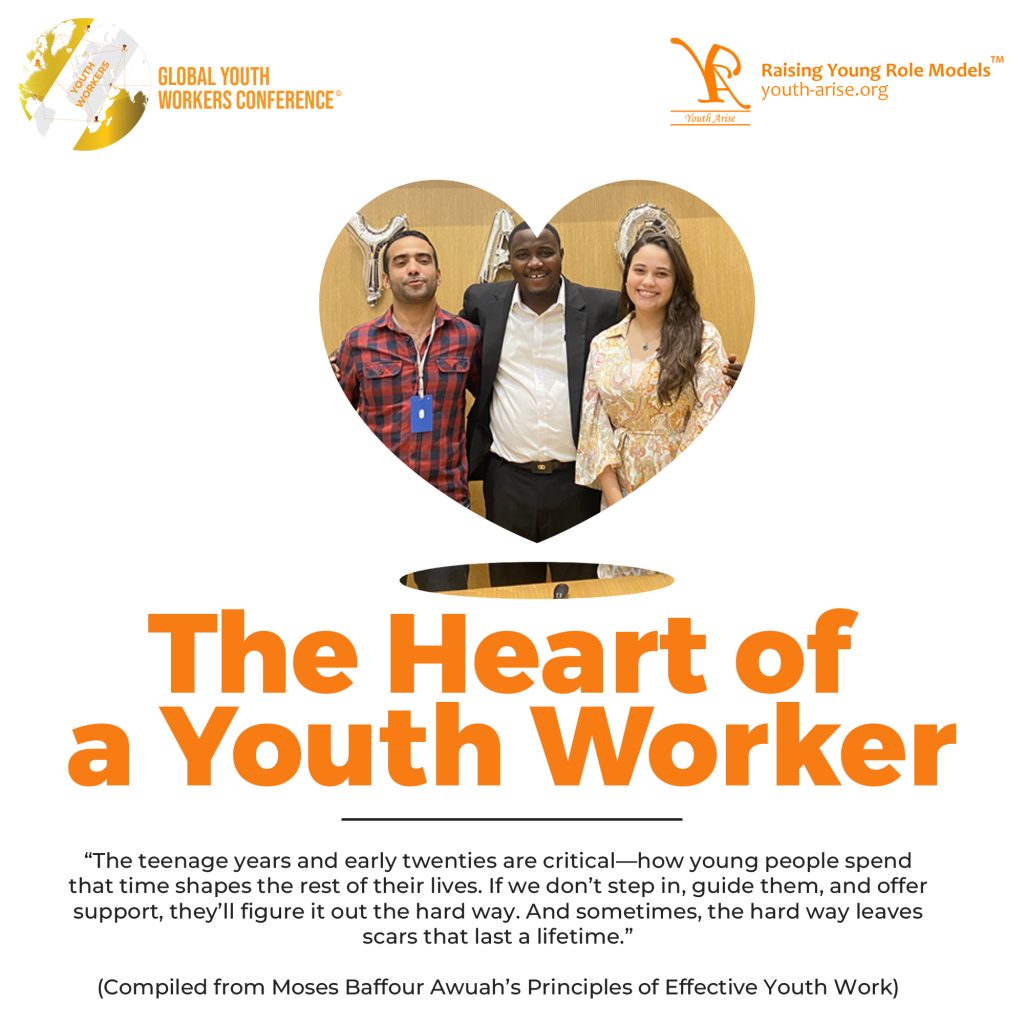
Ever wondered what it means to be a youth worker? Youth work is more than having the right skills—it starts with having the right heart. A youth worker is someone who prioritizes young people, because so much of what happens in our communities depends on how we invest in them. Their future is our future, and if we don’t show up for them, who will? The Sacrifice and Reward of Youth Work Sometimes, being a youth worker feels like a sacrifice—giving your time, energy, and even resources to help others. But the truth is, what you give always comes back. Every effort, every moment spent shaping a young life has a ripple effect. According to the Global CEO of Youth Arise Organization, Moses Baffour Awuah, “It is only when your mind and heart is tuned in a certain way that you can truly be an effective youth worker.” Why Youth Work Matters Youth workers play a vital role in mentorship programs, skill-building workshops, and community projects. These efforts help young people become responsible and productive members of society. The impact is measurable—reduced crime rates, improved educational outcomes, and stronger civic engagement. UNICEF and other organizations emphasize that investing in youth work is key to building sustainable societies. The Heartbeat of a Youth Worker The work requires dedication, resilience, and belief—in young people, in the process, and in yourself. The teenage years and early twenties are critical stages of life. Without guidance, young people may take paths that leave scars for a lifetime. A youth worker steps in to guide, encourage, and create opportunities for a better future. Youth Work Changes You Too One of the untold truths about youth work is that it also transforms the worker. As one youth worker shared: “Sometimes when I’m gloomy, spending time with young people lightens my day. I forget I had a challenge I was dealing with.” Helping others often brings healing, purpose, and fulfillment to those who give of themselves. The Global Youth Workers Conference 2025 That’s why the upcoming Global Youth Workers Conference 2025 is so important. It’s a space where youth workers from across the world will come together to strategize, collaborate, and share best practices. How can we empower more young people? How can we support more youth workers? How can we ensure today’s efforts leave a lasting legacy? Conclusion: The Heart of Youth Work The heart of a youth worker is a heart that beats for change. It chooses to give, to believe, and to show up even when it’s hard. If you feel this calling, don’t ignore it. Youth work may just be the most important thing you ever do. (Compiled from Moses Baffour Awuah’s Principles of Effective Youth Work)
The Future of Youth Work: From History to Global Impact

She was the girl everyone had written off. Teachers saw her as a lost cause, neighbors whispered about her, and even family members doubted her future. She had heard it all—”troublemaker,” “lazy,” “hopeless.” What no one knew was the story behind the anger, the frustration, the disengagement. No one had ever believed in her. Until one person did—a youth worker who saw past the labels, who listened instead of judged, who offered guidance instead of criticism. It wasn’t an overnight transformation, but slowly, with encouragement, she found her voice, her purpose, and her confidence. Today, she is thriving—pursuing her dreams and making the world a better place. These are the stories we remember when we talk about youth work. And they are also what define the future of youth work: belief, empowerment, and transformation. From Tradition to Profession At its core, youth work has always been about nurturing young people into responsible, engaged, and empowered citizens. While its mission has remained constant, the ways in which it is carried out have transformed over time. Historically, caring for and mentoring the younger generation was seen as a communal responsibility rather than a profession. Elders, artisans, and community leaders took young people under their wing, passing down knowledge, values, and skills. In The Force of Mentorship by Moses Baffour Awuah, apprenticeship mentorship is described as one of the highest forms of guidance. With industrialization, children and teenagers faced harsh working conditions, lack of education, and limited opportunities. This created a need for structured youth programs. Organizations like the YMCA (founded in 1844) and the Scouts movement (1907) stepped in, providing character-building, discipline, and a sense of belonging. These early efforts laid the foundation for modern youth work and set the stage for the future of youth work as a professionalized field. Youth Work in Movements and Policy The mid-20th century saw youth becoming powerful agents of change. From the U.S. civil rights movement to anti-apartheid activism in South Africa, young people reshaped nations. Recognizing this, governments and global bodies invested in youth engagement. The United Nations even declared 1985 the International Youth Year, calling for stronger youth participation in decision-making. In Europe, policy frameworks such as the Council Resolution on Youth Work (2010) highlighted the importance of structured youth work in promoting social inclusion, active citizenship, and employment. These global and regional commitments reinforced the value of youth work as more than volunteerism—it became a recognized profession. Technology and Tomorrow’s Youth Engagement The late 20th and early 21st centuries brought a revolution—technology. The internet, social media, and digital platforms transformed how young people connect, learn, and advocate. Youth work no longer required a physical space; it could thrive in online communities, virtual mentorship programs, and global campaigns. Today, the future of youth work includes: Youth Work in Practice: Local to Global In Youth Arise Organization, youth work takes the form of conferences and one-on-one mentoring. For 12 years, through the Leadership Diary Training Programs, hundreds of young people have gained knowledge, confidence, and resilience to face life head-on. These stories remind us that the future of youth work is both deeply personal and broadly systemic. Shaping What Comes Next As we approach the 2030 deadline for the Global Goals, youth work stands at a critical juncture. The question is no longer whether youth work matters—it is how we define its role in shaping the world. Will it be measured by policies enacted, programs launched, or voices amplified? Or will it be seen in the tangible impact of young people breaking barriers, leading solutions, and reimagining the future? Whatever the answer, one truth remains: youth work is not just about helping young people find their place in the world. It is about ensuring they have a world worth stepping into. That is the promise—and the challenge—of the future of youth work.
Global Youth Workers and the SDGs: Why GYWC 2025 Matters

The world urgently needs global youth workers and SDGs to align if we are to achieve real progress. There are less than five years left until 2030. The upcoming GYWC 2025 in Ghana underscores the increasing significance of youth work. Yet within this pressing timeline lies an extraordinary opportunity. Today, 1.8 billion young people form the largest youth population in history—connected, innovative, and deeply committed to social change. With the proper support, they can accelerate progress toward the Sustainable Development Goals (SDGs). Why the SDGs Matter for Young People The SDGs that directly impact young people are more than targets on paper. They shape their daily reality. Quality Education (SDG 4) is a challenge youth face everywhere. Decent Work and Economic Growth (SDG 8) affect them globally. Reduced Inequalities (SDG 10) also impact them. Finally, Climate Action (SDG 13) is a significant concern. Whether it’s finding meaningful jobs, accessing education, or confronting climate risks, the SDGs are essentially a manifesto for their future. For global youth workers and the SDGs, these are priority areas where change must occur rapidly. Africa’s Demographic Opportunity Africa will play a defining role in the future of youth work. By 2030, the continent’s youth population is projected to reach nearly 500 million. This makes Africa the youngest continent in the world. For global youth workers and SDGs, this means one thing. The success of global goals will depend heavily on how well this generation is guided. Additionally, support and empowerment are crucial. Harnessing this energy is not optional; it is essential. A Call to Action Moses Baffour Awuah, Global CEO of Youth Arise Organization, captured this urgency at the Missions to the World Conference 2022. He reminded leaders: “Looking at the challenges of this world, we face a decision. Are we going to leave this world a better place or a worse place? The decision lies on our shoulders. We have no idea what our world will become when we commit to young people. This is because young people are the walls of a nation.” Only 17% of SDG targets are on track, as reported by the United Nations. Nearly 30% have stagnated or reversed. The message is clear. We need accelerated action. Global youth workers and SDGs must be connected through concrete, practical strategies that empower youth to act. The Role of GYWC 2025 The upcoming Global Youth Workers Conference (GYWC) 2025 in Ghana is more than just an event. Under the theme “Youth Workers for Global Goals: Established, Equipped, and Engaged,” it represents a turning point. The conference seeks to transform youth workers into recognized agents of change. It will provide tools, training, and professional standards so that youth workers can mobilize young people effectively toward the SDGs. At the Sharpening Your Saw Conference 2023, Moses Baffour Awuah said: Youth workers are needed in all spheres of influence. They help raise a generation of young people. These young people are committed to making a better world. Evidence of Impact Research by the Commonwealth Secretariat confirms the value of youth work. Countries with strong youth work systems show a 40% increase in youth participation in governance. These countries also exhibit 20% lower youth unemployment rates. These numbers are more than statistics. They represent transformed lives, empowered communities, and stronger societies. This evidence undercuts hand in hand. Structured youth work is not charity; it is a proven strategy for development. Looking Ahead to 2030 The challenge ahead requires a major shift in how we see and support youth work. As GYWC 2025 approaches, the focus is clear: The road to 2030 is demanding, but hope is alive. With 1.8 billion young people ready to act, and with global youth workers and SDGs aligned, lasting change is possible. The GYWC 2025 is a rallying cry. It reminds the world that global youth workers and SDGs are inseparable in the fight for sustainable development. Young people are not just stakeholders in this journey. They are the driving force the world has been waiting for.